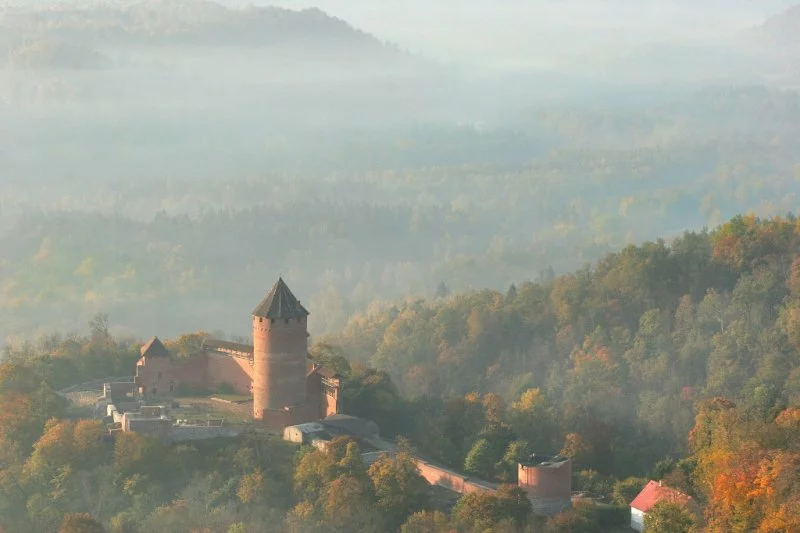
The castles of the Livonian Order were economic centres, fortresses for knights, and convent or meeting buildings. Many residential rooms were needed, so the castles had several stories and several wings with a closed internal yard.
13th century
Before the first stone castle was built on the Turaida hill fort in the early 13th century, the wooden castle of the Liv ruler Kaupo was there. Two years after it was burned down, in 1214, the first fortified building was erected – the so-called Fredeland Castellum (a Latin word for small castles, the word being a diminutive of the word “castrum,” which meant “castle”). The size of the castle increased very rapidly, and by 1218, documents were recording the presence of the fortified Turaida castle, or Castrum Treyden.
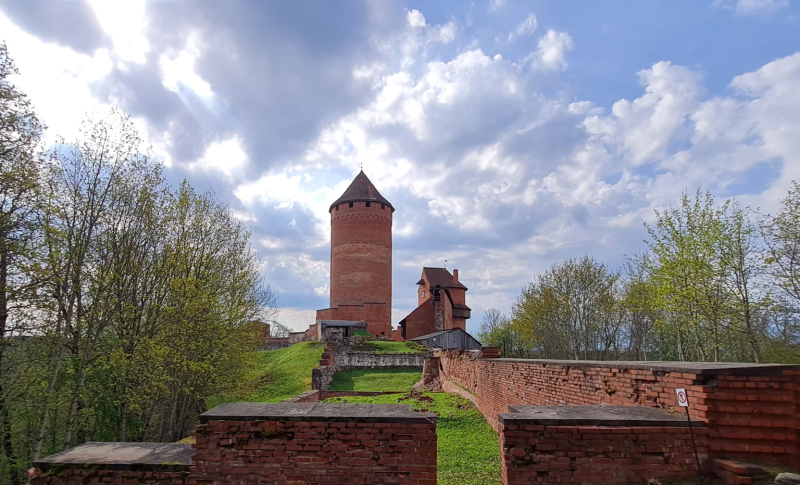
During the first half of the 13th century, the main defensive tower, or Bergfried, was erected at the top of the hill fort. A defensive wall was installed in line with the local terrain. The western side of the hill fort had a fortified residential building known as the “strong house.”
During the latter half of the 13th century, further construction occurred in relation to the north-eastern and southern parts of the castle. In the southern part, a defensive wall was installed, along with a defensive tower for the gate which led to the southern forecastle. The first two floors were used for residential purposes, while the third floor was used to defend the castle.
The north-eastern part of the hill fort was also built up. To the East of the main tower was a building with a semi-cellar that was typical of 13th century architecture. The eastern part of the hill fort was not built up during the 13th century.
14th century
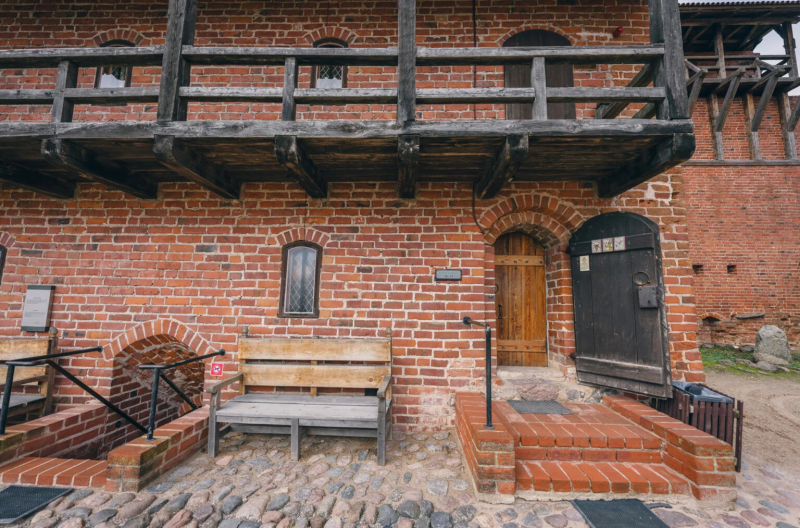
The Turaida Castle was governed by the Livonian Order from 1298 to 1366. As work on the eastern side of the building continued, a structure that was improved over subsequent centuries was erected. 16th century documents describe it as a two-story residential building. A stone staircase led to the wooden gallery on the second floor from the yard, and it led to interior rooms. There is little information about the rooms, though we know some had vaulted ceilings. The vaults were based on octagonal lime columns, and fragments of these have been found by archaeologists.
By the latter half of the 14th century, a wall had been erected around the southern forecastle. It was rebuilt in later centuries, thus narrowing the area of the forecastle.
15th century
There was much rebuilding of the western part of the castle during the 15th century. A higher and thicker defensive wall was installed on the western side and toward the yard. Along the north-western area, the western wing or new hall was erected. This structure had a cellar, two floors and an attic. The architecture was simple and in line with the military nature of the castle.
Firearms appeared in Livonia during the 15th century, and this meant the need for a new type of defensive structure – towers for cannons. A large semi-circular tower was installed in the western wing of the Turaida Castle to stretch partly beyond the defensive wall. A small semi-circular tower was installed outside the defensive wall of the southern forecastle, as well. On the western side of the tower-shaped southern wing, a residential addition was erected, while the southern wing received a stove to heat the building. The southern forecastle’s southern section was used as a stable for the horses.
The northern side of the castle was strengthened during the 15th century with the installation of a forecastle with an external gate and two defensive towers linked to a passage with stone walls on either side.
16th century
The political situation in North-Eastern Europe underwent radical changes during the 16th century, with powerful forces amassing against Livonia. Rīga Archbishop Jasper Linde (1509-1524) strengthened the defensive systems of his castles because of this. A round cannon tower with many firing apertures was built in the north-western part of the Turaida Castle yard to protect the northern forecastle.
The castle was larger during the 16th century than at any time before or after, and it was the most highly fortified castle of its age. Once firearms began to develop, however, the military importance of Turaida and similar stone castles began to recede.
17th to 21st century
The northern forecastle was sacked during the Polish-Swedish War (1600-1629), and the redoubt that was the last defensive structure of the Turaida Castle was built after the war was over. Materials from the northern defensive wall were used for this purpose to a certain extent, and this ended the construction history of the Turaida Castle and fortress.
After a major fire in 1776, the military buildings were not renewed. Local residents used the remaining buildings for economic purposes and to get building materials for their own structures. In 1786, the owner of the Turaida Estate built a wooden residence for himself amid the ruins, and it was only torn down in 1953. The Medieval buildings gradually deteriorated into romantic ruins, and they attracted the attention of students of antiquity. There are maps, drawings and descriptions of the castle ruins from the 19th and 20th century.
The Turaida Castle ruins were put on the list of protected monuments in Latvia in 1925. The first steps to conserve the Medieval structures began soon after. Beginning in the 1970s, a major study of the castle and its territory was conducted to find ways of preserving and restoring them. A number of ancient building elements were found during this process – some 4,700 ceramic tiles for stoves, approximately 3,500 fragments of window glass, some 7,500 construction nails, approximately 4,000 other building elements, etc.
Materials used in the construction of the Turaida Castle
Clay building materials were typical for the Turaida Castle – bricks, roof shingles and tiles. These were manufactured near the castle. Appropriate locations to extract red clay were found some 500 m to the North of the castle. The quarries were later filled in to create fishing ponds for the local estate.
The size, colour and form of the bricks characterise the development of the Turaida Castle from the 13th to the 18th century. The largest bricks, each weighing more than 8.5 kg, were used for the first residential buildings of the bishop, the main tower, and the tower-shaped southern wing of the building. Medium-size bricks were used during the 15th and 16th century, when the most intensive work was done on the castle.
The window and door apertures of the castle were decorated with profile bricks. Some bricks with Medieval plastering have survived.
The tiles used to cover the roof had curved edges and little hooks to fasten them together. There were specific forms for these tiles to ensure that they were narrower at one end. Semicircular tiles were used during the early days of the castle. The roof was covered from the bottom, layering the tiles up to the top. Gaps between lower tiles were covered with higher tiles. The higher tiles were known as “monks,” while the lower ones were called “nuns.” The semicircular tile roof weighed between 96 and 120 kg per square metre, and beginning in the 15th century, lighter tongue-shaped tiles were produced instead. During the 16th century, Dutch masters were producing even lighter and more plastic tiles. Dutch tiles appeared at the Turaida Castle shortly before the 1776 fire.